





















- HYGEIA
- Virtual tour
- Services
- Maternity Clinic
- Maternity Clinic Medical Services
- Paediatric Clinic


- HYGEIA
HYGEIA
- Virtual tour
Virtual tour
- Services
Services
- Maternity Clinic
Maternity Clinic
The Neurodegenerative Brain Diseases Department -Memory Clinic specializes in the diagnosis and treatment of usually chronic diseases that are the result of the degeneration of brain neurons. The most common of these are dementias (Alzheimer disease, Vascular dementia, Frontotemporal dementias, Creutzfeldt-Jakob disease, encephalopathies of various etiologies, etc.) and Parkinson’s disease.
The Department is staffed by a team of specialists (neurologists, psychiatrists and cognitive neuropsychologists) and offers comprehensive clinical and paraclinical evaluation of patients with cognitive deficits. It is supported by the laboratory departments of HYGEIA, which offer the world’s most advanced methods of studying these diseases (MRI, amyloid PET, DAT SCAN, genetic testing, detection of biomarkers in cerebrospinal fluid and blood).
The evaluation includes clinical neurological and psychiatric assessment, as well as specialized neuropsychological testing (tests of memory and other cognitive functions).
Paraclinical examination (blood and biochemical tests, brain imaging, examination of cerebrospinal fluid) is then recommended. Depending on the results , treatment with approved dementia medications is prescribed and an individual treatment plan is drawn up for each patient. In parallel, individualized cognitive training programs are provided to patients as well as psychosocial support sessions to their caregivers.
Alzheimer disease is the most common form of dementia (70-80 % of all cases) and affects 5% of people over the age of 65. Due to increasing life expectancy worldwide, the number of patients with dementia is expected to rise dramatically in the coming years.
In the brains of Alzheimer patients, clusters of abnormal proteins, such as senile plaques of beta-amyloid and neurofibrillary tangles of tau protein, accumulate in specific areas that control cognitive function. This pathological process leads to the degeneration and death of brain cells, resulting in a reduction in brain volume and impaired cognitive function.
New etiological treatments for Alzheimer disease – Anti-amyloid monoclonal antibodies
Monoclonal antibodies against beta-amyloid are the first etiological treatment for Alzheimer disease. They reduce the burden of amyloid plaques in patients’ brains, resulting in a significant slowing of the clinical progression of the disease, up to 36%. Monoclonal antibodies are indicated for selected patients with Mild Cognitive Impairment or early Alzheimer disease. It requires documented diagnosis with biomarkers (cerebrospinal fluid proteins or amyloid PET).
The monoclonal antibodies Lecanemab and Donanemab have been approved in the United States and in Europe and recently in Greece.
They are administered intravenously (once a month for donanemab, twice a month for lecanemab) in a one-day-clinic setting. Their use demands a strict protocol of handling and monitoring adverse events, such as ARIA (amyloid related imaging abnormalities). Symptomatic ARIA, leading to pause of treatment, arise in a small percentage, <5 %. For the above reasons, anti-amyloid monoclonal antibodies are administered in specialized and certified centers including Memory Clinic of HYGEIA HOSPITAL.
Amyloid PET imaging
It is an innovative, non-invasive, imaging technique for the early and accurate diagnosis of Alzheimer disease with extremely high sensitivity and specificity.
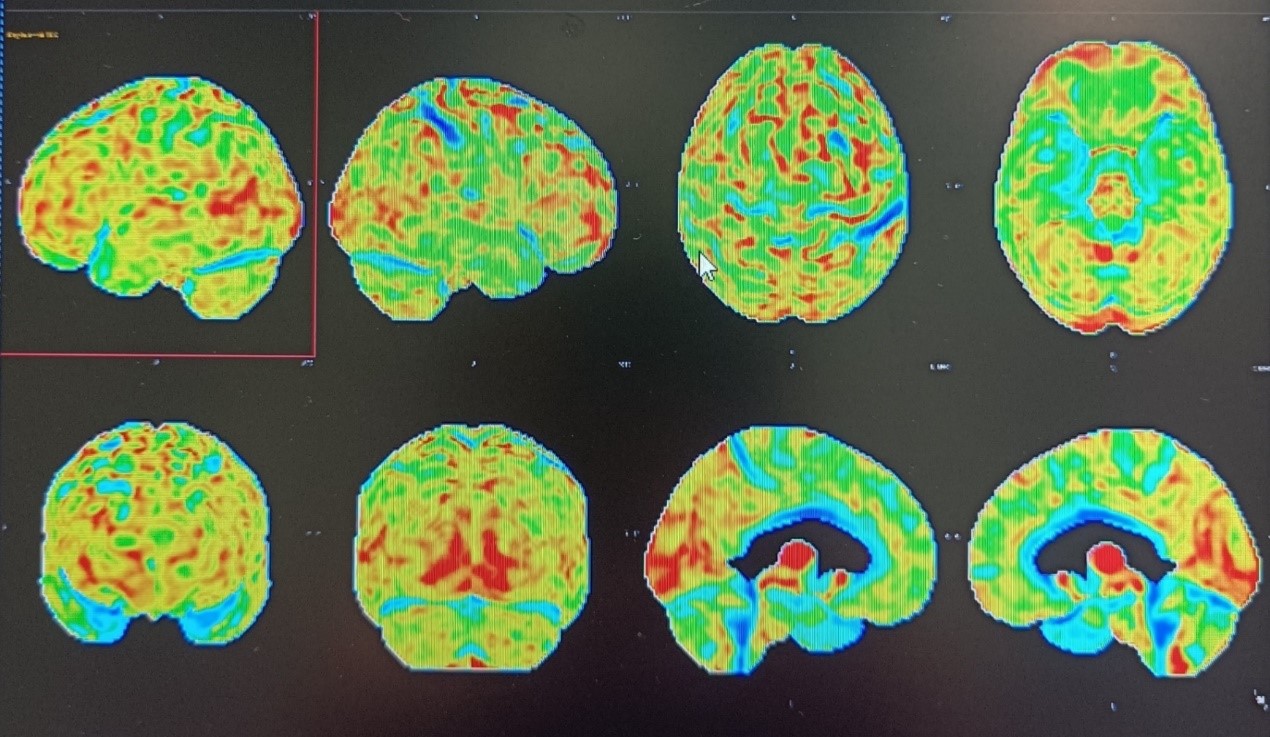 PET-CT DEPARTMENT, HYGEIA HOSPITAL
Clinical trials for new drugs for Alzheimer diseaseWorldwide, numerous clinical trials of new drugs for Alzheimer disease are being conducted. These are pharmaceutical agents that have been proven safe and effective in small, controlled studies and are now being tested in larger populations in order to obtain marketing authorization. Clinical trials involve volunteer patients who receive the investigational drug under close medical monitoring. The Memory Clinic conducts clinical trials of new drugs with the approval of Hellenic National Medicines Agency (EOF) and the Scientific Council of the Hospital.
The standard diagnostic procedure includes clinical neurological and psychiatric assessment as well as specialiazed neuropsychological testing.
Depending on the individual, the following apply:
A. Paraclinical Investigation
- Standard blood tests to rule out secondary dementias
- Specialized blood tests: ApoE allele, pTau217, pTau217/Aβ42
- Cerebrospinal Fluid testing: detection of pathological proteins : Aβ amyloid, Tau protein, Phospho-tau protein, RTQuIC )
- Brain imaging
Structural: MRI (specific protocols)
Functional brain imaging: HMPAO SPECT, DAT scan, amyloid PET- CT
B. Neuropsychological Evaluation
Standardized neuropsychological tests assessing memory and other cognitive functions
C. Follow up
Following the diagnosis, special protocols of treatment and follow- up visits are applied. HYGEIA Hospital has both the technology and medical staff to carry out all of the above mentioned clinical and paraclinical examinations which are necessary for the diagnosis of neurodegenerative diseases.
Services provided :
- Neurological examination
- Psychiatric examination
- Neuropsychological assessment
- Lumbar puncture and cerebrospinal fluid (CSF) testing to examine for the presence of specific proteins related to Alzheimer’s disease
- Genetic testing for Alzheimer’s disease in the blood – genetic counseling
- Psychosocial support and counseling for caregivers
- Cognitive training programs (pen and paper, Computerized cognitive training)
The Department of Neurodegenerative Brain Diseases is in contact and collaborates with services and organizations in the community, in particular, with Alzheimer organizations (Alzheimer Athens – www.alzheimerathens.gr) which play a very important role in the overall management of dementia by supporting patients’ rights and offering education and support to their families. It also collaborates with international organizations such as Alzheimer Europe, Alzheimer Disease International, Eurocarers, Alzheimer Association etc.



 Contact Us
7th floor
Οffice 7.1
(Erythrou Stavrou 5 – opposite Hygeia Hospital)Τelephone
+ 30 210 686 7079Medical Team
- Director
-
 Sakka Paraskevi
 - Αttending Physicians
-
 Nikolaou Konstantinos
 -
 Geronikola Nikoletta
 -
Kalligerou Faidra
-
Kondyli Kynthia
-
 Potamianou Dimitra
- Services
- Virtual tour
- Paediatric Clinic
- Services
- Virtual tour